
Intelligent Agility: How Innovation Teams Adapt Without Losing Direction
Sep 21, 2026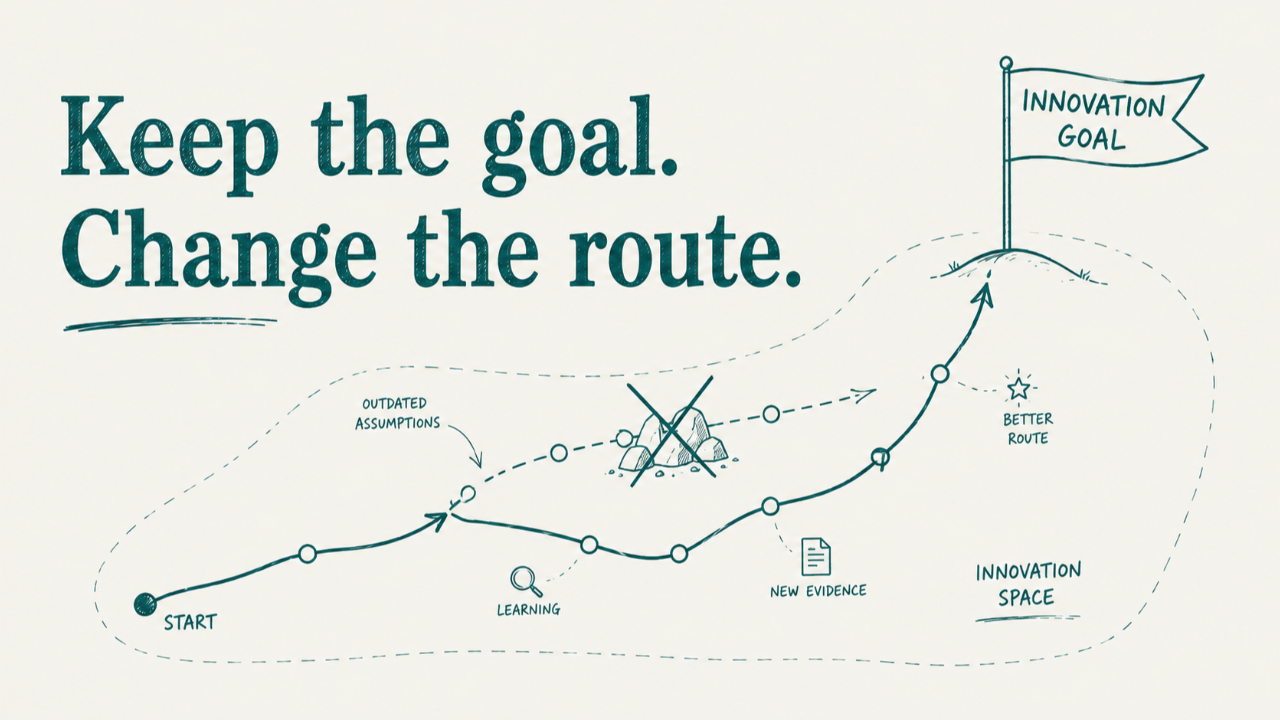
Innovation teams are often told to be agile.
Adapt quickly. Respond to change. Stay flexible. Do not become trapped by the original plan.
All sensible advice.
But flexibility on its own is not enough.
If every change in circumstances leads to another change in direction, agility can quickly become drift. Teams keep moving, but gradually lose sight of what they were trying to achieve in the first place.
At the other extreme, detailed planning can create the opposite problem. Teams become so committed to the route they designed that they continue following it even when reality has changed.
The real innovation capability lies somewhere between those extremes.
In innovation management, I call it intelligent agility.
Intelligent agility is the ability to recognise when reality has changed, understand what that change means, and adapt the route without losing the purpose and intended value of the innovation.
Intelligent agility is not about changing constantly or replacing planning with agile methods. It is the capability to use learning and changing evidence to make better innovation decisions while maintaining direction.
The goal of agility is not to change quickly. It is to change intelligently.
Why innovation plans become outdated
Innovation plans are created with the information available at a particular moment.
You make assumptions about customers, technologies, markets, partners, regulation, timing and available resources. Based on those assumptions, you design a route forward.
There is nothing wrong with that.
The problem is that innovation happens in environments where those assumptions rarely remain stable.
A new technology appears. A competitor changes the market. A customer responds differently than expected. Regulation shifts. A partner discovers something unexpected. An experiment disproves an assumption that looked perfectly reasonable three months earlier.
Reality moves.
And when reality moves, a perfectly logical plan can become the wrong plan.
That does not mean planning failed.
It means the plan reflected the best available understanding at the moment it was created.
The real question is what happens when that understanding changes.
Why outdated plans are not an argument against planning
There is a tempting conclusion to draw from all this:
“If reality changes anyway, why spend so much time planning?”
I hear variations of this surprisingly often in innovation. Forecasts prove wrong, assumptions change, plans become outdated, so teams decide to stay open and simply learn as they go.
That sounds agile.
But without enough preparation, it can quickly turn into expensive trial and error.
Typical symptoms are:
- testing ideas without being clear about what needs to be learned
- exploring opportunities without knowing which ones matter strategically
- changing direction without understanding why the previous route failed
The result can be a lot of activity, but surprisingly little learning.
You spend development time on options that could have been ruled out earlier. Partners explore in different directions. Experiments answer interesting questions rather than important ones. Opportunities are missed because nobody identified them systematically.
In a competitive environment, the cost is not only the money you spend. It is also the opportunity you miss while your team is learning something it could have understood earlier.
The fact that a plan may become outdated is not an argument against planning. It is an argument for planning in a way that helps you learn and adapt.
Good preparation does not attempt to predict every step.
It defines the purpose, identifies important assumptions, maps relevant boundaries and considers possible routes before major resources are committed.
Instead of random trial and error, you get purposeful learning.
You still experiment. You still discover surprises. You still change direction.
But each experiment helps you make a better next decision.
This also fits well with the thinking behind the ISO 56000 family of innovation management standards. Innovation happens under uncertainty, so teams need to test assumptions, learn from evidence and adjust as their understanding develops.
In that sense, innovation can be seen as learning under uncertainty.
Planning should therefore not pretend to eliminate uncertainty. It should help identify which uncertainties matter and where learning will create the most value.
Innovation resources are limited. Time spent exploring one route cannot be spent exploring another. Money invested in the wrong experiment cannot be invested twice.
Planning does not remove uncertainty.
It helps you spend your uncertainty budget more intelligently.
Planning and agility in innovation are not opposites
Good preparation actually makes meaningful agility easier.
When teams understand why a particular route was chosen, they can assess whether that reasoning still holds when circumstances change.
They know what value they are trying to create, who should benefit, which assumptions matter, which boundaries are important and which choices were simply practical responses to the situation at that moment.
That shared understanding creates room to adapt.
A plan becomes dangerous when people know what they are supposed to do but no longer understand why they are doing it.
A strong plan does not eliminate change. It gives you a reference point for deciding how to respond to change.
When innovation agility turns into drift
Imagine an innovation project where customer feedback suddenly challenges one of the central assumptions.
A rigid team might say:
“We agreed on the plan, so we should execute it.”
A poorly structured agile team might say:
“The customer reacted differently. Let us try something else.”
An intelligently agile team asks:
“What has changed, which assumption does this challenge, and what does it mean for the value we are trying to create?”
That is a very different conversation.
The objective is not to protect every decision that was made earlier. It is to protect the reasoning and purpose behind the project.
Sometimes that means changing a feature or technical approach. Sometimes a partner needs a different role, the scope needs to shift, or the intelligent decision is simply to stop.
Agility becomes useful when teams can distinguish between what should remain relatively stable and what should remain open.
Intelligent agility starts with a clear innovation goal
If everything can move, there is no direction.
In innovation projects, the most important reference point is usually the innovation goal.
That goal is often already there.
In research and innovation proposals, defining the project objective or innovation goal is typically a mandatory part of the application. Teams spend considerable effort explaining what they want to achieve, why it matters and what should be different when the project succeeds.
Yet once the proposal is approved, that innovation goal can gradually disappear behind work packages, deliverables, milestones and deadlines.
The plan becomes visible.
The purpose becomes implicit.
Intelligent agility reverses that hierarchy.
When circumstances change, the first question should not be:
“Can we still execute the work package as planned?”
It should be:
“Can we still achieve the innovation goal in the way we planned, or has reality given us a better route?”
The innovation goal should remain the compass, while the route towards it is allowed to evolve.
The goal should usually be more stable than the route, but it is not sacred. Strong evidence can also show that the innovation goal itself needs refinement.
This connects to a principle I describe in Win Winnovation: define the innovation space clearly enough that partners understand what they are trying to achieve, while leaving enough freedom to adapt how they get there.
The innovation space clarifies the boundaries of the project, where partners' interests overlap, and where there is still freedom to explore.
A useful way to think about it is:
- Innovation goal: where do we want to go?
- Innovation space: where can we manoeuvre?
- NABC: what questions help us decide whether the route still makes sense?
- Plan: what is our current route?
This is where the NABC framework becomes particularly useful.
NABC keeps four fundamental questions visible:
- Need: What need are we addressing?
- Approach: How do we currently intend to address it?
- Benefits: What value should this create, and for whom?
- Competition or alternatives: Why should this approach be preferable to the available alternatives?
These elements do not all have the same level of stability.
The need and intended value may remain relatively stable, while the approach can change considerably as the team learns. New evidence may even change how the need itself is understood.
That is exactly why NABC works well as a reference for intelligent agility.
If new technology appears, ask whether it enables a better approach.
If customer behaviour changes, revisit the need and benefits.
If a competitor introduces something unexpected, reconsider the alternatives.
If testing shows that the expected value is weak, question whether the innovation goal itself needs refinement.
This turns adaptation into structured reasoning rather than improvisation.
It also connects naturally to the broader process of turning early ideas into stronger innovation concepts through structured NABC reasoning.
Think of navigation software.
When you miss an exit, the system does not insist that you reverse the car and return to the original route.
It recalculates.
But it can only do that because the destination is still clear.
Innovation needs the same logic.
You can change the route intelligently when everyone understands the innovation goal and the reasoning behind it.
Shared reasoning matters more than shared documentation
This becomes even more important in collaborative innovation.
A project document captures objectives, tasks, milestones and responsibilities.
What it rarely captures completely is the reasoning that led to those decisions.
Why was one option preferred over another?
Which assumptions were debated?
Which risks were accepted?
What alternatives were rejected?
When only a small core team understands that reasoning, adaptation becomes difficult.
This is particularly visible when the people executing an innovation project are not the same people who originally designed it.
They inherit the plan but not necessarily the thinking behind it.
When circumstances change, they can either keep executing what is written or restart a lengthy alignment process.
Neither is particularly agile.
Partners who understand the reasoning can do something much more valuable.
They can help rethink the route.
That is one reason why strong collaboration requires more than distributing tasks. Partners need enough shared ownership to question assumptions, challenge choices and contribute to the next decision.
This ability to recognise and correct misalignment is closely related to detecting and correcting drift in innovation collaborations.
Different perspectives improve adaptation
No single person sees all of reality.
Different people naturally notice different parts of the challenge:
- technical experts see feasibility
- users see friction
- commercial teams see market dynamics
- researchers see emerging knowledge
- operations teams see implementation constraints
- leadership sees strategic priorities
- external partners may notice assumptions that have become invisible inside your own organisation
That diversity becomes particularly valuable when circumstances change.
The point of collaboration is not simply to collect more information. It is to combine perspectives so the group can make a better decision than any individual participant could make alone.
But that only works when people feel able to challenge the original direction.
If every alternative is interpreted as criticism of the original plan, teams will defend past decisions instead of responding to present reality.
Intelligent agility therefore also depends on collaboration culture.
People need enough trust to say:
“I think one of our assumptions no longer holds.”
When that trust is present, changing direction becomes less defensive. Partners can explore what changed together without turning every adjustment into a discussion about who was wrong.
And they need enough shared purpose to hear that statement as useful information rather than resistance.
Three capabilities behind intelligent agility
Intelligent agility sounds simple, but it rests on several learnable capabilities.
1. Make assumptions visible
Every innovation project contains assumptions.
Some concern technology. Others concern users, markets, timing, partners or internal decision making.
You do not need to eliminate uncertainty. That would be impossible.
But you should know which assumptions matter enough to revisit when new information appears.
An assumption that remains invisible cannot be consciously challenged.
2. Capture the why behind important decisions
You do not need to document every discussion.
But for important decisions, capture enough of the reasoning to explain why.
Which assumptions mattered?
What alternatives were considered?
Which trade offs were accepted?
This makes future adaptation much easier because the team can evaluate whether the original logic is still valid.
3. Create moments for deliberate course correction
Projects need moments where the question is not simply:
“Are we on schedule?”
They also need moments where teams ask:
“Does this still make sense?”
Those are very different questions.
A project can be perfectly on schedule while becoming increasingly irrelevant.
Regularly reviewing assumptions, context and expected value helps teams detect drift before it becomes expensive.
Progress is not only about moving forward. Sometimes progress means recognising that the best next step points in another direction.
Leadership should protect the purpose, not the plan
There is an important leadership implication here.
When leaders strongly celebrate execution against plan, teams quickly learn that changing direction is risky.
Even when everyone can see that circumstances have changed, people continue delivering what was originally agreed.
Not because they lack agility.
Because the organisation rewards predictability.
Strong innovation leadership sends a different signal.
The purpose matters. The value matters. The strategic boundaries matter.
The route can be questioned.
That does not remove accountability. In fact, it increases it.
Changing direction should not be based on preference, politics or the newest shiny idea.
The team should be able to explain what changed, which assumption is affected, why the current route is becoming weaker, and how an alternative better protects the intended value.
That is intelligent adaptation rather than random movement.
Structure creates freedom when it is designed well
This is where innovation management sometimes gets misunderstood.
Structure is often seen as the opposite of agility.
But the right structure creates freedom.
Clear goals make experimentation safer.
Explicit assumptions make learning faster.
Shared decision rules make course correction easier.
Good governance reduces the need to renegotiate everything when circumstances change.
Clear collaboration agreements help partners adapt without reopening the entire partnership.
The purpose of innovation structure should not be to make reality obey the plan.
It should help teams respond effectively when reality does not.
This is also why innovation structure should reduce friction rather than create bureaucracy.
That is a very different way of looking at innovation management.
A practical test for your current innovation project
Think about one innovation project you are involved in today.
Imagine that tomorrow you discover that one important assumption is wrong.
A new technology makes your chosen approach outdated. A major customer wants something different. Regulation changes. A partner can no longer deliver what was expected.
Would people know which assumption had changed?
Would they understand the innovation goal well enough to evaluate alternatives?
Would partners feel authorised to challenge the current route?
Could the team adapt without restarting the whole project discussion?
Your answers tell you quite a lot about the real agility of your innovation system.
Intelligent agility improves the chances of innovation success
Innovation will always contain uncertainty.
The answer is neither endless flexibility nor increasingly detailed planning.
It is building teams and partnerships that can interpret change together.
Teams that understand the innovation goal.
Teams that know their innovation space.
Teams that make important assumptions visible.
Teams that use structured reasoning rather than random trial and error.
Teams that combine different perspectives.
Teams that recognise when reality has moved.
And teams that can adjust their route without losing sight of the value they are trying to create.
That capability makes innovation more resilient, keeps projects relevant and increases the chance that effort ultimately turns into results and sustainable growth.
Because the strongest innovation teams are not the ones whose plans always prove correct.
They are the ones who know what to do when they do not.
If this reflects challenges you recognise in your own innovation projects and you want to explore how to create more adaptive ways of working, you can get in touch through the contact page. I am happy to think along with you.
Hey!

